

Artificial intelligence is rapidly becoming part of the basic infrastructure of legal work. It can summarize, analyse, compare, draft, and detect patterns at a speed no human can match.
But producing an answer is not the same as creating an outcome.
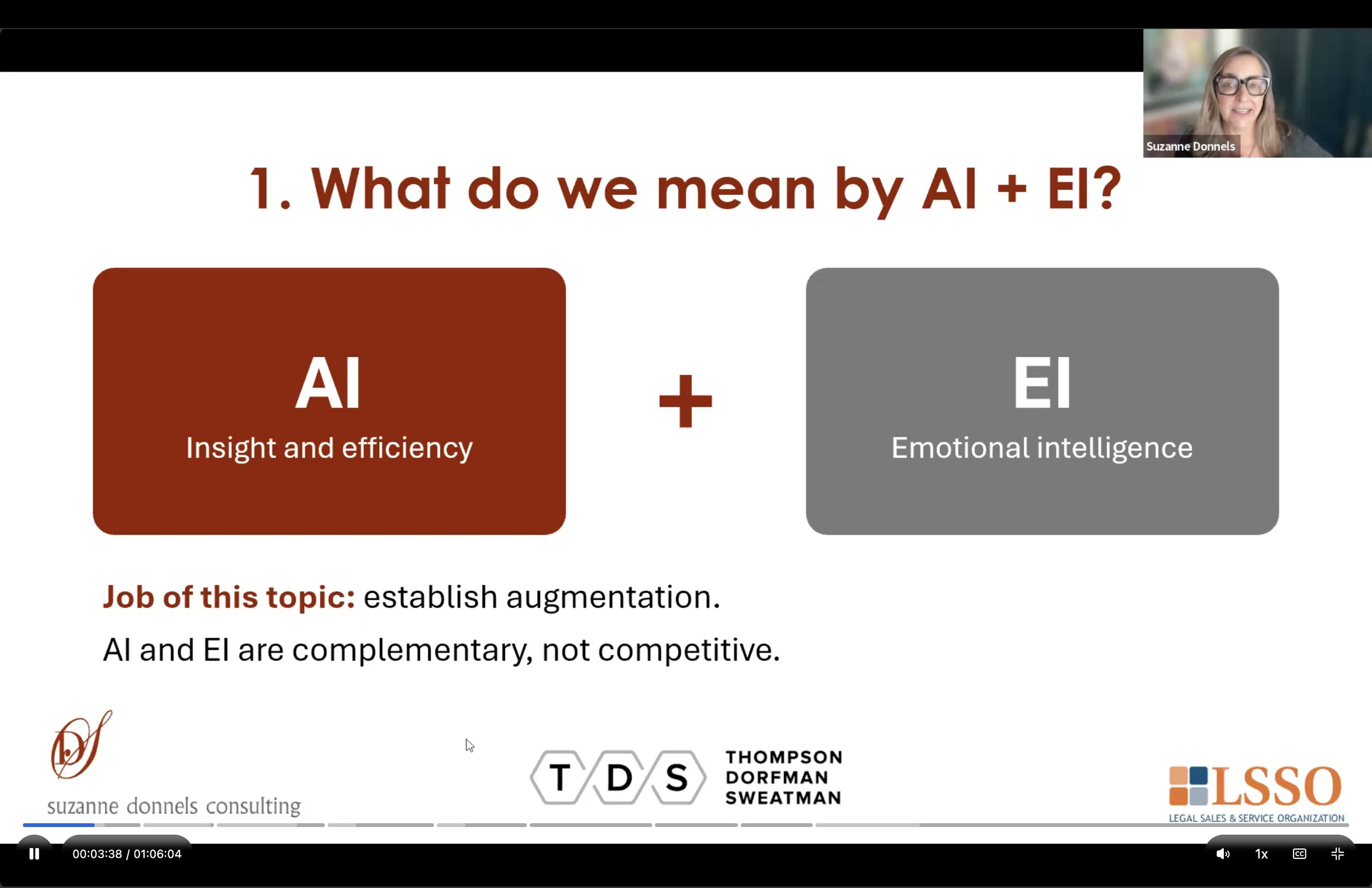
That was the premise of a recent webinar I presented with Mark Howe for the Legal Sales and Service Organization: the future of law firm growth is not artificial intelligence or emotional intelligence. It is AI + EI.
As AI becomes table stakes, what will distinguish one law firm from another will not be access to better technology. It will be the firm’s ability to combine that technology with stronger human judgement, deeper client understanding, and more trusted relationships.
The important question comes after AI produces an answer
Much of the discussion about AI has focused on what the technology can do. Increasingly, however, the more consequential questions are:
Who tests the answer?
Who understands its context?
Who recognizes what may be missing?
Who decides what matters?
Who communicates the insight effectively?
Who has earned enough trust for another person to act on it?
Those are not technology questions. They are questions of judgement, context, communication, and trust.
That is where emotional intelligence becomes the trust layer.
AI contributes speed, scale, and pattern recognition. Emotional intelligence contributes curiosity, empathy, timing, and an understanding of the people and circumstances behind the data. Human judgement connects the two.
The opportunity is not to choose between human and artificial intelligence. It is to combine them to produce outcomes that neither could achieve as effectively alone.
From information to actionable intelligence
Law firms already possess enormous amounts of information about their clients, relationships, matters, industries, and experience. AI can help organize that information and identify patterns that might otherwise remain hidden.
For example, AI can:
Surface relevant experience for a pitch
Identify connections between lawyers and prospective clients
Summarize client feedback
Detect changes in a client’s business or industry
Suggest opportunities for collaboration or follow-up
But a recommendation generated by technology is still only a starting point.
A system may identify a relationship, but it cannot fully understand its strength, history, or sensitivity. It may detect an opportunity, but it cannot know whether this is the right moment to pursue it. It may summarize feedback, but it cannot independently appreciate everything that was communicated through tone, contradiction, hesitation, or what the client chose not to say.
The most effective professionals will use AI to expand what they can see, then apply emotional intelligence and judgement to decide what to do next.
Curiosity is still a competitive advantage
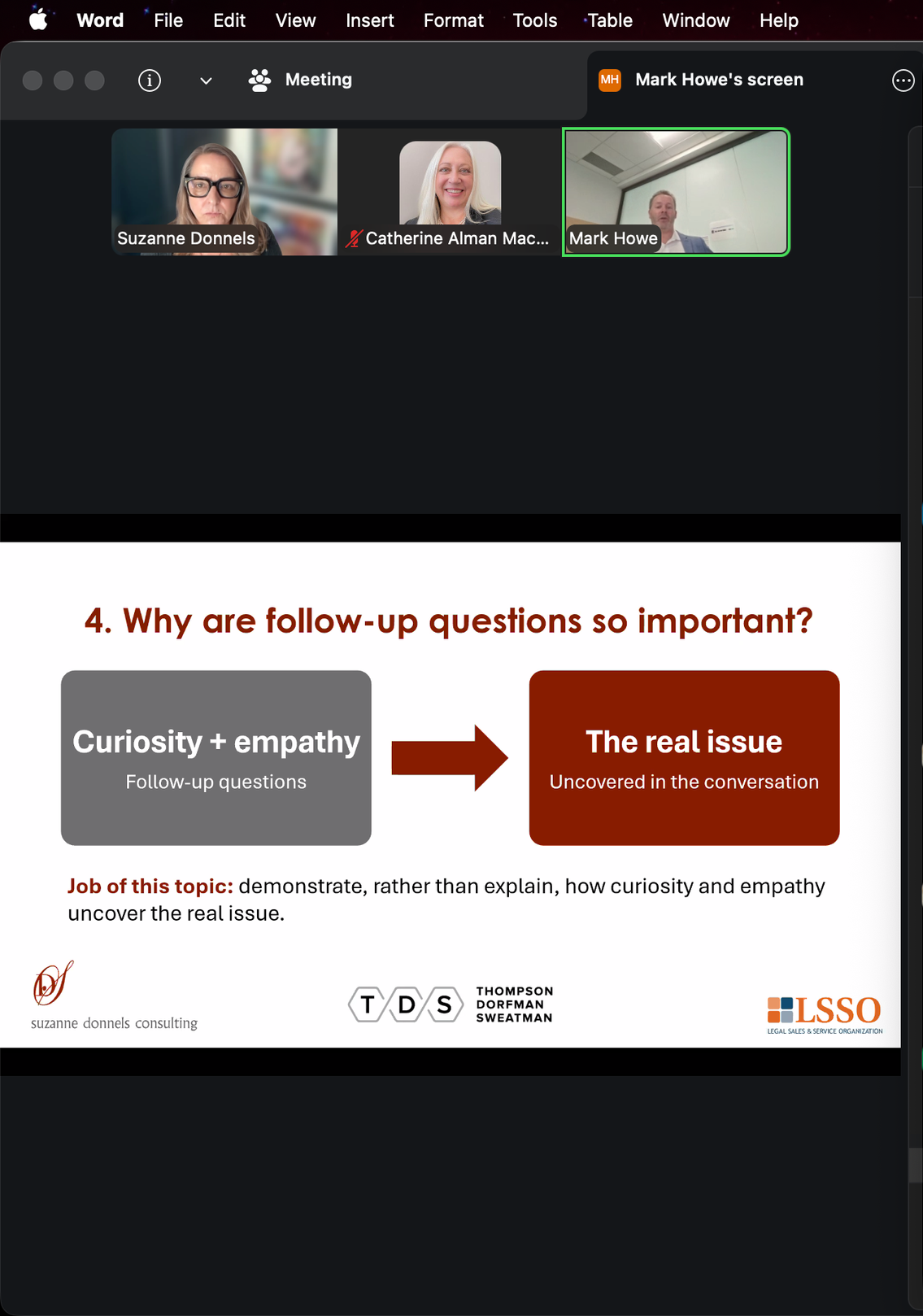
One of the practical themes that emerged during the webinar was the importance of asking better questions.
When information is incomplete or contradictory, the answer is not necessarily to dismiss it as an error. It may be an invitation to become more curious.
A discrepancy in client feedback can lead to a valuable clarification. An unexpected AI-generated connection can prompt a conversation about the history of a relationship. A pattern in client data can help a lawyer notice something that deserves a more personal follow-up.
AI can help us arrive at the question more quickly. It does not eliminate the need to ask it.
Those conversations are often where the real value is created.
Better data matters, but so does better human input
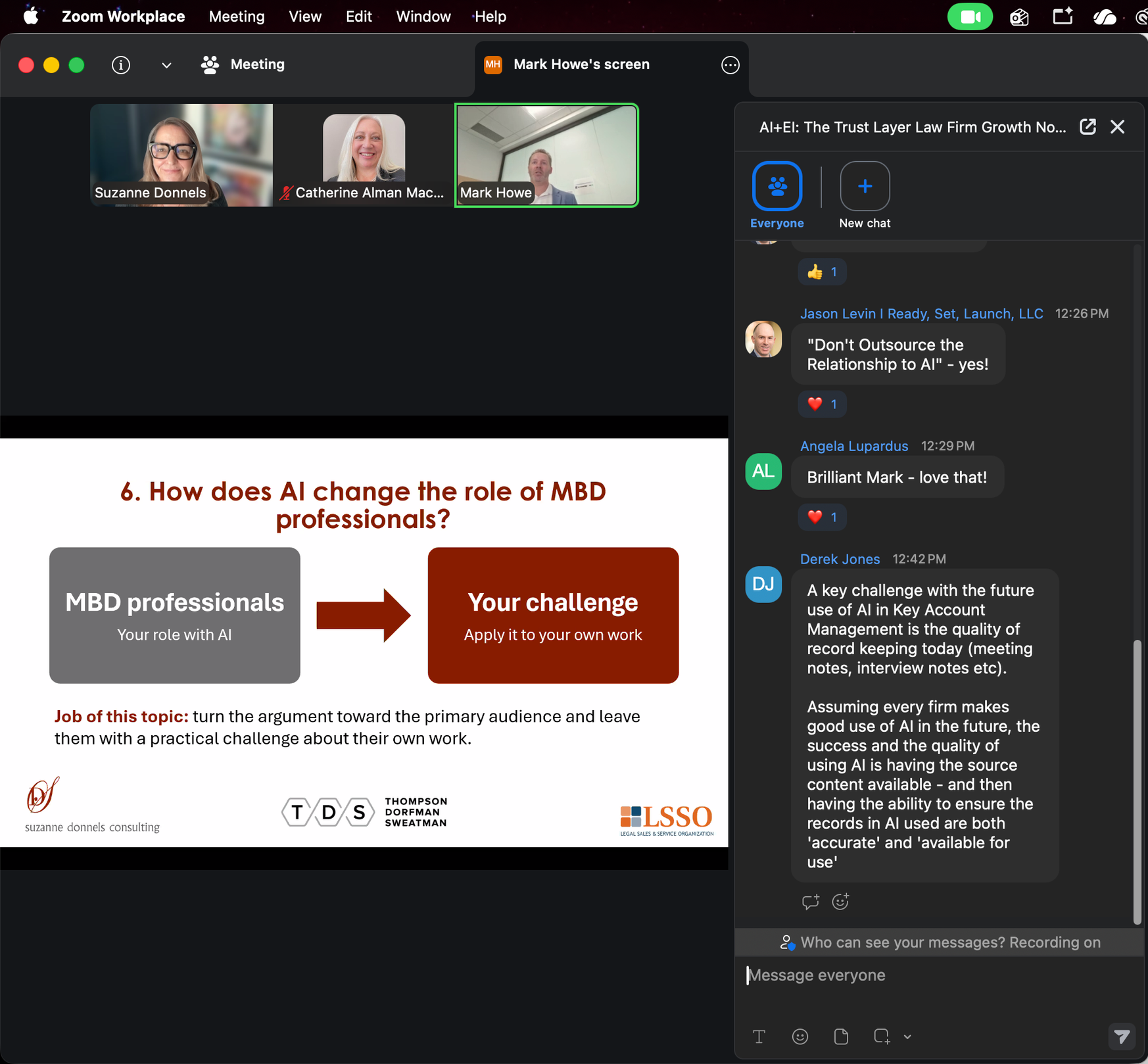
AI systems are only as useful as the information available to them. That is particularly important in law firms, where some of the richest relationship intelligence still resides in people’s memories, inboxes, calendars, and personal experiences rather than in a centralized system.
Technology can help firms bring more of that information together, but interviews, client feedback, relationship conversations, and professional observations remain essential. They provide the nuance that data alone cannot supply.
The strongest approach combines both:
Structured data that can be analysed at scale
Qualitative information that explains the story behind the data
Human judgement that determines what is relevant
Emotional intelligence that guides how and when to act
This combination allows firms not only to understand what has happened, but also to anticipate what may happen next.
Trust remains the differentiator
AI will continue to improve, and its use in law firms will grow. Many of today’s technological advantages will eventually become commonplace.
Trust will not.
Clients still need to believe that their advisers understand their businesses, recognize their concerns, exercise sound judgement, and communicate with care. Lawyers still need trusted relationships with colleagues if they are going to share opportunities, collaborate across practices, and introduce one another to important clients.
Technology can support those relationships. It can help people prepare more thoroughly, notice more connections, and respond more intelligently. But it cannot substitute for the work of building trust.
The firms that benefit most from AI will not simply be the ones that deploy the newest tools. They will be the firms that help their people use those tools with curiosity, judgement, empathy, and purpose.
AI can help us see more.
Emotional intelligence helps us understand what we are seeing.
Human judgement helps us decide what to do about it.
That is the combination that will turn artificial intelligence into meaningful law firm growth.