

Turning Referees into Rankings: A Strategic Guide for Chambers Canada Submissions
Chambers rankings are widely recognized as a benchmark for Canadian law firms, but earning a top spot involves more than submitting polished materials. The client referee process is frequently underestimated and treated as a routine task completed at the last minute, rather than as a strategic priority. Client referees, which refers to the clients and peers who provide feedback to Chambers researchers, play a decisive role in your ranking and often make up most of the evaluation criteria. Firms that approach referee engagement thoughtfully and proactively are positioned to achieve stronger results in the Chambers assessment.
One practice in a firm, which struggled with senior statesperson retirement and limited table recognition of the next generation of leaders, took a more strategic approach to referee management and messaging, which realized desired results and a Band 1 practice ranking.
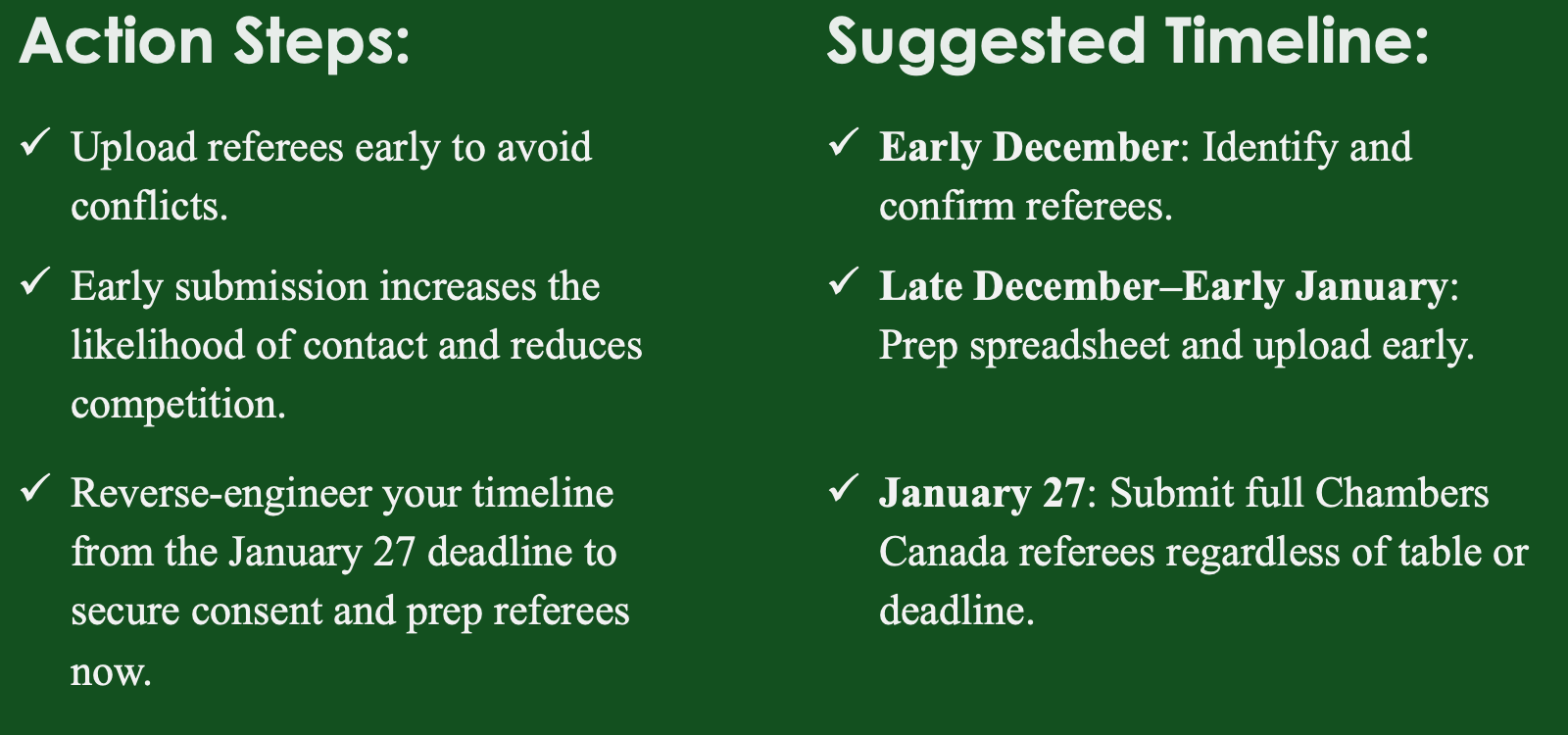
With the Chambers Canada submission deadline on January 27 looming, now is the time to act. Firms that leverage referees effectively, rather than scrambling at the eleventh hour, can gain a significant edge in the rankings.
This guide provides a step-by-step framework for legal marketers and law firm leaders to harness the power of Chambers referees. It covers why referees matter, how Chambers’ research team operates, and best practices for selecting, coaching, and tracking your referees. It also explains the “90-day cool-down” rule, the five inputs Chambers uses in its evaluation, and how to align your referee strategy with broader business development goals.
Section 1: Why Referees Matter
Referee feedback contributes approximately 50–60% of Chambers’ evaluation. Researchers use referee input to validate submissions and assess qualities like responsiveness, trustworthiness, and effectiveness. Strong referee engagement can tip the scales in your favor, especially for firms or lawyers on the cusp of a higher band or seeking to break into the rankings.
Referees provide real-world validation and color that elevate a submission from good to great. Their feedback confirms the claims made in your submission and adds nuance that written matter summaries often lack. For rising stars or newly ranked individuals, exceptional client feedback is often the deciding factor.
Section 2: Chambers’ Five Inputs
Your messaging needs to be consistent, not identical, across each of the five inputs Chambers uses to evaluate firms:
A. Submission – Matter summaries and firm overview.
B. Referee or Client Feedback – Interviews and surveys.
C. Lawyer Conversations with Researchers – Partner interviews.
D. Leadership’s Conversation with Guide Editor – Strategic context.
E. Market Commentators – Peer and competitor feedback.
Consistency across these inputs builds credibility. Discrepancies weaken your case. Align your themes and differentiators across all touchpoints.
Key Terms Explained: Making Chambers Jargon Accessible
Table Recognition: Inclusion and visibility of lawyers or practice groups in Chambers’ published ranking tables, which are used by clients to identify top talent.
90-day Cool-Down: A rule where Chambers researchers will not contact the same referee more than once in a 90-day period. If a referee is submitted by multiple firms, only the first submission is contacted, so early action is critical.
Inputs: The five main sources Chambers uses to evaluate law firms: (1) Submission documents (matter summaries and firm overview), (2) Referee or client feedback (interviews/surveys), (3) Lawyer conversations with researchers, (4) Leadership’s conversation with the guide editor, (5) Market commentary (peer and competitor feedback).
Section 3: Chambers Researchers
Researchers are smart and diligent but may not have deep subject-matter expertise. They rely on clear, well-organized submissions and interviews to understand the significance of your work. Treat them as informed laypeople, explain context and differentiators clearly.
Chambers researchers often move into legal marketing roles, making the Chambers research team a feeder for U.K. firm BD talent. This dynamic means they respond well to structured, strategic communication.
Chambers has more than 300 researchers, mostly based in London.
Many researchers are early-career professionals, often fresh out of university.
Those who stay in the role longer become quite knowledgeable about their assigned practice areas and jurisdictions.
Chambers is very good at promoting from within, so the researcher of today could be the guide editor in the future.
In-house marketing professionals often struggle to navigate the process when partners are frustrated or lack a solid understanding of Chambers, sometimes believing that Chambers never gets it right. Partners and firms may think they understand the process but are missing key elements.
It is essential for your marketing and BD team to become friends and allies with the Chambers researchers. You will eventually need the researcher’s help, so being kind and useful will win points.
Look out for a future article on researcher and editor meeting preparation.
Section 4: Timing and Early Action
Timing is everything. Chambers operates under a “90-day cool-down” rule, meaning if the same individual is listed as a referee for multiple firms or submissions, Chambers will not contact them more than once within a three-month span. If another firm lists your referee first, you may lose the opportunity for feedback. This not only impacts your local country or guide, but guides from other jurisdictions. If your referee cannot locate the Chambers email in their inbox or spam filter, you can ask the researcher if you can have the referee email the researcher directly.
Section 5: Selecting the Right Referees
The best referees are those who know your work well, are inclined to speak positively, and are available to talk. Avoid listing high-profile names who may not respond or lack detailed knowledge of your matters. If possible, steer clear of referees that you would share with several other law firms. During their call with the researcher, the referee would need to give airtime to each law firm. The more firms, the less time your referee spends on you and your firm.
Substance over rank: Choose engaged, knowledgeable contacts over high-profile names. Researchers do not prioritize titles.
Availability: Mid-level contacts often have more time and fewer competing firms.
Matter familiarity and recent collaboration are key.
Include a mix of long-term and new clients for balanced feedback.
Consider non-client referees (co-counsel, opposing counsel, third-party professionals) when appropriate.
Use each reference only once per season and for one table.
Watch the referee tracker, do not reuse non-responders.
Be mindful of cross-guide conflicts due to the “90-day cool-down” rule.
Common Mistakes and How to Avoid Them
Last-minute referee selection.
Over-reliance on titles.
Failing to track responses.
Copy-pasting talking points.
When firms represent clients across multiple practices or locations that fall under different Chambers tables, supply a distinct referee for each practice or office. If using the same referee for more than one practice or office is unavoidable, be explicit with that referee about everything they must cover: list each practice area, each office/location, and the specific individuals (partners or lawyers) whose work should be discussed. Give the referee clear guidance on which matters, timeframes, and roles to mention so their feedback addresses each relevant table fully and separately.
Look out for a future article on strategically selecting the partners and associates to put forth in each table and guide and why.
Section 6: Aligning Referee Strategy and Messaging with Firm Goals
Chambers referee outreach is a strategic opportunity. Use it to reinforce your brand, support succession planning, and gather client insights. Treat referees as VIPs, they are your top clients and advocates. They are the lynchpin for keeping the work you have expanding to new work.
Integrate referee selection with broader practice BD and branding strategy.
Identify value-adds or talking points for each lawyer on each matter and spread those across referees.
Use referee feedback to support rising talent (e.g., associates or junior partners).
Repurpose positive feedback for pitches, coaching, and client development.
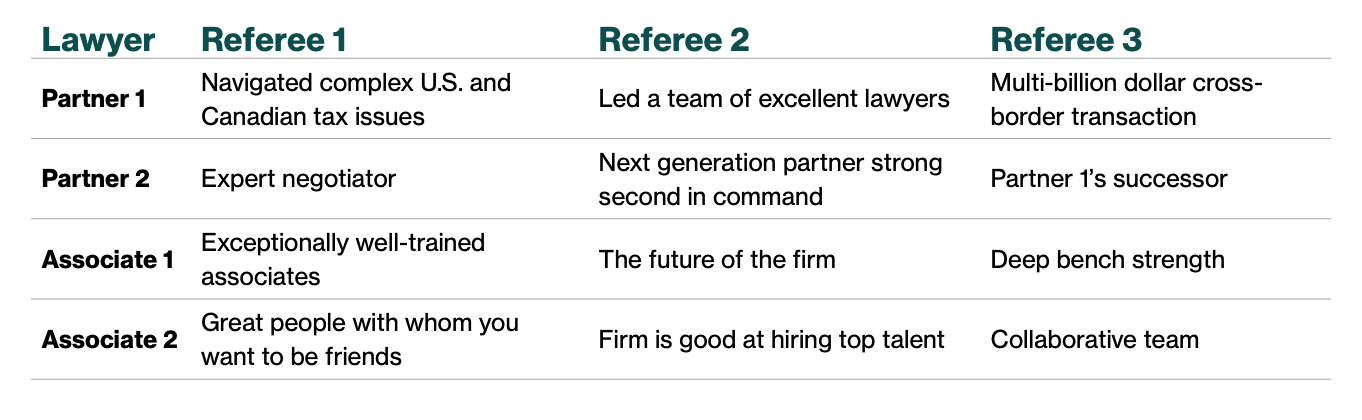
Draw from the work done for each client/referee and distribute talking points so each referee can speak to the researcher about the lawyers they work with. Each referee should convey your themes that that can be about the specific individual and/or the team as a whole; however, be mindful to not have each referee say exactly the same thing. Chambers will notice, if you copy and paste them to each referee.
This table offers an example of how you to spread key points or themes across referees. Altogether, these themes should mirror what you articulated in your submission. Of course, what you articulate must be authentic and true.
Section 7: Coaching and Preparing Referees
Preparation is key. Remind referees of the work you did together and the value you delivered. Encourage them to speak candidly and specifically. A 10-minute phone call often yields richer feedback than a written survey.
Secure consent and explain the process.
Brief referees on key differentiators and recent matters.
Encourage verbal feedback (calls) over written surveys when possible.
Provide timing guidance and set expectations for outreach.
Avoid sending identical talking points to each referee, Chambers will notice.
Thank referees after they’ve participated. This strengthens the relationship and increases the likelihood they’ll serve as a reference again.
Look out for a future article on Chambers’ Insights Report benefits.
Section 8: Follow-Up and Tracking
Track referee responses and intervene when necessary. A high response rate (90%+) strengthens your submission. Keep records of who responded and who did not for future planning.
Use tools like the Chambers Referee Management Tool to monitor responses.
Follow up tactfully to ensure feedback is submitted.
Address issues like spam filters or missed emails promptly.
If your referee didn’t hear from Chambers, ask the researcher if you can connect them or have the client email directly.
If the “90-day cool-down” rule applies, your referee can give consent to Chambers to reach out, just let the researcher know.
Expanded Case Study:
Strategic Referee Management for Practice Advancement
Background and Challenges:
A leading practice group within a Canadian law firm faced a significant transition when its most senior statesperson retired. This departure left the firm with limited table recognition (meaning their lawyers were not prominently listed in the Chambers ranking tables, which display ranked individuals and practices. And their lawyers were not well known by Chambers). Emerging leaders struggled to gain visibility, and the group risked losing ground in both reputation and rankings.
Actions Taken:
To address these challenges, the firm adopted a focused referee strategy with several concrete steps:
Referee Selection: The team prioritized clients and peers who had recent, direct experience with the group’s work. Rather than relying on high-profile names or general contacts, they chose individuals who could speak specifically about the practice’s strengths and recent matters.
Mapping Relationships: The firm created a detailed matrix to ensure referees represented a mix of long-standing clients, new relationships, co-counsel, and third-party professionals. This diversity provided well-rounded feedback and avoided overlap with other firms, reducing the risk of losing out due to the 90-day cool-down rule.
Refined Messaging: The marketing team worked closely with lawyers to draft customized talking points for each referee. These highlighted unique accomplishments, such as successfully navigating complex cross-border issues, leading many billion-dollar transactions, engaging a team with deep bench strength, and changing the way that people live and work in Toronto. Messaging was tailored so each referee could authentically discuss the team or individual’s strengths, avoiding repetitive or generic statements.
Early Engagement: Referees were contacted well before the submission deadline. The partners explained the Chambers process, secured consent, and provided guidance about what to expect. Referees were encouraged to participate in phone interviews rather than written surveys to provide richer, more nuanced feedback.
Active Tracking: Using a referee management tool, the BD team monitored response rates and followed up promptly when feedback was missing or emails went to spam. They kept detailed records to avoid reusing non-responders and to plan for future submissions.
Challenges Faced:
Uncovering each matter value adds (that were not articulated in any of the firm’s systems) by engaging with partners and diving into the work done on the partner’s largest matters. Oftentimes busy partners do not remember what they worked on or realize the unique aspects of each matter since they have probably worked on 10 others in the same week.
Initial resistance from partners who believed high-profile referee names alone would suffice.
Difficulty convincing referees to participate due to time constraints or lack of familiarity with the Chambers process.
Managing the risk of shared referees with other firms, especially in competitive practice areas.
Measurable Outcomes:
Through these targeted actions, the practice achieved:
A 90%+ referee response rate, significantly higher than previous years.
Consistent, positive feedback across all five Chambers inputs (the five sources Chambers uses to evaluate: submission documents, referee feedback, lawyer interviews, leadership interviews, and market commentary).
Recognition of emerging leaders in the ranking tables, with several junior partners and associates named for the first time.
Ultimately, the group was awarded a coveted Band 1 ranking, the highest tier, reflecting top performance in its field.
Best Practices:
Actionable Steps for Referee Selection, Messaging, and Follow-Up:
Start Early: Identify and confirm referees at least two months before the deadline to avoid conflicts and maximize your chances of feedback.
Choose Strategically: Select referees who know your work well, are likely to respond, and can provide specific examples. Avoid sharing referees with competing firms when possible.
Customize Messaging: Provide each referee with tailored talking points that highlight different aspects of your team’s work. Avoid copy-pasting; authenticity is key.
Coach Referees: Brief referees on the process, set expectations, and encourage verbal feedback for richer responses. Secure consent and thank them for their participation.
Track and Follow Up: Use management tools to monitor who has responded and follow up if necessary. Address technical issues like spam filters promptly.
Align with Firm Goals: Integrate your referee strategy with broader business development and branding efforts. Use feedback to support rising talent and reinforce your firm’s strengths.
Conclusion:
Accessible and Actionable Guidance for Every Experience Level
Referee management is more than a compliance task; it is a strategic lever that can elevate your Chambers Canada submission and your firm’s reputation. By taking a proactive approach, selecting the right referees, refining your messaging, and tracking results, you set your firm up for success. Whether you are new to Chambers submissions or seeking to improve your process, following these steps will make your guide more effective and accessible for everyone involved.
Beyond rankings, Chambers offers strategic benefits that many firms overlook. A less than popular sentiment. It strengthens client engagement, reinforces brand consistency, and provides market intelligence that informs competitive positioning. The process trains business development talent, giving them practical experience in client communication and strategic planning. It also uncovers value adds for each matter that are often missed by other systems, helping you articulate differentiators and client impact. Finally, it supports succession planning and creates a structured approach to relationship management, turning referee outreach into a client-care initiative.